
This is a clip of a TED talk style video with Muskaan Muse Laroyia from Brain and Climate Equity talking about why the adolescent brain is different.
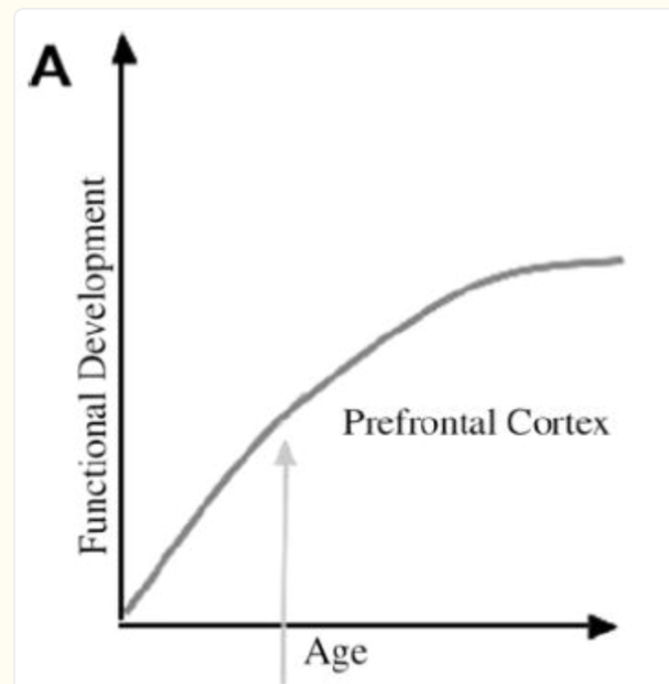
Graph A is a traditional view. Historically, adolescent behavior was attributed almost entirely to the slow, linear maturation of the prefrontal cortex alone.
Casey, B. J., Getz, S., & Galvan, A. (2008). The adolescent brain. Developmental review : DR. https://pmc.ncbi.nlm.nih.gov/articles/PMC2500212/
Graph B is the current neurological model. Modern research highlights a functional developmental imbalance. Subcortical limbic regions (such as the nucleus accumbens) mature earlier than top-down prefrontal control regions. During adolescence, behavior is more heavily biased by these fully active, reward- and emotion-driven limbic structures while the prefrontal cortex is still maturing. By adulthood, both systems reach full maturity and balance.

PREFRONTAL CORTEX
Prefrontal Cortex Functions & Practical Examples
-
Emotional Regulation: Processing intense reactions; underdeveloped regulation makes it difficult to calm down after receiving an ambiguous message.
-
Working Memory: Holding and manipulating information; an example is continually replaying a conversation in one's head while trying to concentrate on homework.
-
Impulse Control: Hesitating before acting; underdeveloped control can lead to actions like sending a message before thinking through the consequences.
-
Planning: Managing schedules and time; an example is choosing to stay up late to talk despite having an early school start.
The prefrontal cortex (PFC) is responsible for higher-order cognitive functions, including planning, organizing, controlling, and executing behavior. Because it undergoes protracted development and continues maturing until around age 25, cognitive control and top-down impulse control are still developing during adolescence.
IMPACTS ON ROMANTIC ENGAGEMENT:
Professional, C. C. M. (2026, March 11). Limbic system. Cleveland Clinic. https://my.clevelandclinic.org/health/body/limbic-system
Romantic interactions during adolescence carry strong emotional and social significance because they trigger multiple subcortical reward pathways simultaneously:
-
Social Reward: Receiving affection, attention, or acceptance.
-
Anticipation: The excitement and uncertainty of waiting to see if feelings are reciprocated or if a text will arrive.
-
Learning: Reinforcing which words, behaviors, and social interactions yield positive responses.
-
Emotional Significance: Interpreting a romantic interest's actions as central to personal identity and peer standing.

REWARD AND MOTIVATION PROCESSING:
-
Nucleus Accumbens & Ventral Striatum: Participate in reward processing, motivation, and learning which experiences are worth pursuing. The simple anticipation of a rewarding interaction serves as a strong driver of behavior.
-
Ventral Tegmental Area (VTA): Contains dopamine-producing neurons that project to the striatum and prefrontal cortex, driving motivation and the active pursuit of rewarding experiences.
CORE STRUCTURES OF THE LIMBIC SYSTEM:
Hypothalamus: Produces hormones and regulates mood, sleep, hunger, thirst, body temperature, blood pressure, heart rate, and sexual arousal
Amygdala: Regulates emotional significance and feelings (such as fear, anger, and anxiety), memory, and social interpretations of others.
Hippocampus: Primary structure responsible for forming new long-term memories.
Thalamus: Processes sensory information (touch, sight, hearing, and taste) and assists with memory, planning, and emotions
LIMBIC SYSTEM:
Adolescent behavior is not governed by a single isolated structure, but by interconnected brain systems that process emotional significance, rewards, motivation, and learning.
CIRCADIAN RHYTYMS:
Circadian rhythms are internal 24-hour biological cycles that manage sleep-wake states, hormone secretion, body temperature, alertness, and core physiological processes.
